
Cryotherapy for HPV Treatment
Wart Freezing Method
What is Cryotherapy?
Cryotherapy is based on the principle of destroying wart tissue by freezing it with liquid nitrogen. The freezing process creates ice crystals inside the cells, and these crystals break the cell membrane, causing burn-like damage in the tissue.
As a result of this process, the wart tissue loses its vitality, a blister forms within a few days, and then the necrotic tissue sheds, starting the healing process.
TOPICS
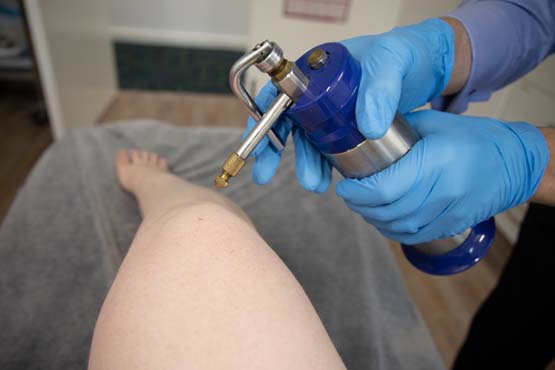
How is Cryotherapy Applied?
The procedure is quite simple. Liquid nitrogen (-196°C) is applied to the wart using a spray or a cotton-tipped applicator. Each application usually lasts 5–30 seconds.
During freezing, there is a burning and stinging sensation; most patients describe it as “tolerable but uncomfortable.” After the application, a fluid-filled blister (bulla) is expected to form in the area, there's no need to worry. The blister dries up on its own within a few days, and the dead tissue sheds.
How Many Sessions Are Needed?
The depth that cryotherapy can reach is limited. Therefore, especially for large, widespread, or deeply rooted genital warts, multiple sessions are needed for the same lesion. Usually, 2–3 weeks are waited between sessions.
So the treatment may spread over several months. Knowing this in advance is better than being disappointed later with “isn't it over yet”.
Strengths of Cryotherapy
Let's give the method its due — cryotherapy has real advantages:
- Cheap and accessible. It does not require expensive equipment and is available in many centers.
- Can be safely used during pregnancy. Since it is applied without administering medication to the body, it is one of the few methods that can be preferred during pregnancy.
- Does not leave a hard scar (scar, keloid). Since it affects by freezing rather than cutting the tissue, it does not create fibrotic scar tissue.
Does it Leave a Scar, Does it Cause Color Change?
I hear this question a lot, and the answer is twofold — it's important not to confuse the two.
It does not leave a hard scar. We do not expect keloid or raised scar tissue after cryotherapy. This is a real advantage of this method.
But the situation is different when it comes to color. The freezing process affects not only the wart tissue but also the pigment cells responsible for the skin's color. Therefore, the risk of lightening (hypopigmentation) and discoloration in the application area is indeed significant, and these changes can be permanent.
In the genital area, this is not a detail to be overlooked. A light-colored area left after the wart has gone can be as bothersome as the wart itself for some patients. On darker skin tones, this difference appears even more pronounced.
Other Side Effects
- Blister (bulla) formation in the application area
- Superficial wound (ulceration)
- Risk of infection due to tissue destruction
- Pain, burning sensation during and after the procedure
Do Warts Recur?
Cryotherapy is a local treatment; it targets only the wart tissue we can see. It cannot directly reach the presence of HPV in the deeper layers of the skin. This is a common limitation for all local methods.
Here, I want to tell you separately what both the literature and my own observations say, because they do not say exactly the same thing.
What the literature says: No definitive superiority has been shown between cryotherapy and laser in terms of total clearance rate. More studies are needed on this. I wrote this in my own book chapter as well.
What I see in my practice: Especially in widespread and recurrent genital warts, I find the recurrence high after cryotherapy. This is my clinical observation, and it is what determines my treatment preference.
I Do Not Perform Cryotherapy in My Clinic
Let me be clear: cryotherapy is not performed in our center. I say this not as a deficiency, but as a conscious choice.
I have two reasons. The first is my observation of recurrence mentioned above. The second is that I do not find the possibility of permanent color change in the genital area acceptable for my patients. Genital warts are already a sufficiently distressing issue; I do not want a permanent color mark left after treatment.
This does not mean that cryotherapy is a bad method. I have colleagues who practice it, and it works for the right patient. It's just not the method I prefer. If you are considering cryotherapy, you should apply to a center that offers this method.
So, Which Method is Suitable for You?
You don't need to choose the answer to this from the internet — it's not something to be chosen anyway. In the treatment of genital warts, the method is determined not by the patient's preference but by the location, number, and spread of the lesion. This decision is made during the examination, after seeing the warts.
In our center, our standard practice is fractional carbon dioxide laser. In specific locations such as the rectum and vaginal side wall, electrocauterisation may be preferred. We will discuss which is suitable for you during the examination.
Frequently Asked Questions
What is Cryotherapy?
It is the process of destroying wart tissue by freezing it with liquid nitrogen. Freezing creates ice crystals within the cell; these crystals disrupt the cell structure and the tissue loses its vitality.
How many sessions does cryotherapy take?
It varies depending on the size and depth of the lesion, often requiring more than one session. The intervals between sessions are usually 2–3 weeks.
Will there be a scar after cryotherapy?
It does not leave a hard scar (scar, keloid). However, hypopigmentation and color irregularity that can be permanent may be seen in the application area. This is the most important point to be careful about in the genital area.
Is the recurrence rate high in cryotherapy?
In the literature, no definitive superiority has been shown between cryotherapy and laser in terms of total clearance. In my own clinical practice, I find the recurrence high, especially in widespread and recurrent warts — this is my personal observation.
Can cryotherapy be applied during pregnancy?
Yes. Since it is applied without administering medication to the body, it is considered one of the safe methods during pregnancy. If you are pregnant, be sure to make the treatment decision together with your doctor.
Is cryotherapy performed at your center?
No. In our center, genital wart treatment is performed with fractional carbon dioxide laser; electrocauterisation is used in certain locations.
Source: Ağar E. Laser Applications in Genital Wart Treatment. In: Güncel Kadın Hastalıkları ve Doğum Çalışmaları. Ankara: Akademisyen Kitabevi; 2021. p. 35-45.
The evaluations regarding the treatment preference on this page are based on the author's own clinical practices and are of a personal opinion nature. The page is for informational purposes and does not replace examination and physician evaluation.
Frequently Asked Questions
What is cryotherapy?
It is the process of destroying wart tissue by freezing it with liquid nitrogen. Freezing creates ice crystals inside the cell; these crystals disrupt the cell structure and the tissue loses its vitality.
How many sessions does cryotherapy take?
It varies according to the size and depth of the lesion, and usually more than one session is required. Session intervals are generally 2-3 weeks.
Does cryotherapy leave a scar?
It does not leave a hard scar (scar, keloid). However, hypopigmentation and color irregularity that can be permanent may be seen in the application area. This is the most important point to be careful about in the genital area.
Is the recurrence rate high in cryotherapy?
In the literature, no definitive superiority has been shown between cryotherapy and laser in terms of total clearance. Dr. Eser Ağar states that he finds the recurrence high, especially in widespread and recurrent warts, in his own clinical practice; this is a personal clinical observation.
Can cryotherapy be applied during pregnancy?
Yes. Since it is applied without administering medication to the body, it is considered one of the safe methods during pregnancy. The treatment decision should be made together with the doctor during pregnancy.
Is cryotherapy performed at your center?
No. In our center, genital wart treatment is performed with fractional carbon dioxide laser; electrocauterisation is used in certain locations such as the rectum and vaginal side wall.
Medically reviewed: Asst. Prof. Eser Ağar, MD —


Related Topics