
In Which Cases Is Conization Performed?
If a lesion seen during colposcopy extends towards the cervical canal, or if risky cells are detected as a result of endocervical curettage, the conization procedure is preferred.
- CIN 2 or CIN 3
- An HSIL cytology result
- Lesions extending into the endocervical canal
- Suspicion of early-stage cervical cancer
How Is Conization Performed?
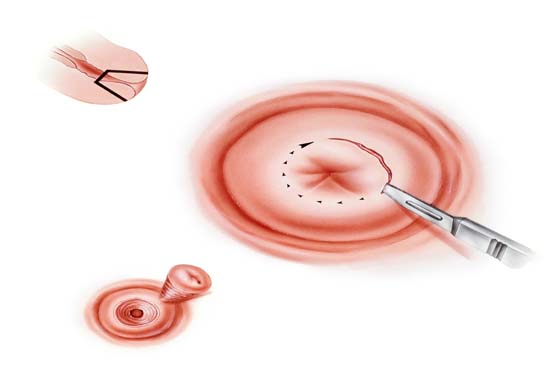
Conization is performed under operating-room conditions. The diseased part of the cervix is removed in a cone shape. The method performed with a blade is called cold-knife conization.
Compared to the LEEP procedure, it is technically more difficult and the risk of bleeding is higher. Bleeding is brought under control with electrocautery and sutures.
The Process After Conization
The removed tissue is sent for pathology. A follow-up and treatment plan is determined according to the result.
- If the margins are clear, regular follow-up is carried out.
- If the margins are positive, an additional procedure may be needed.
- If there is invasive cancer, the patient is referred to gynecologic oncology.
Are There Risks to Conization?
Bleeding, infection and, rarely, narrowing of the cervix can be seen. In patients planning a pregnancy, the risk of cervical insufficiency should be taken into account.
Conization is a surgical procedure that is both diagnostic and therapeutic, aiming at the complete removal of precancerous cells.
Dr. Eser Agar – Tirana, Albania
You can contact us for a detailed assessment of conization surgery and cervical conditions.
- 📞 Phone: +355 69 836 15 65
- 📱 WhatsApp: +355 69 456 44 67


Related Topics